
High Performance Stage: More Than Results
In modern football, the High Performance stage is often reduced to one single outcome: results. Wins, league positions, trophies. While results matter, they are only the visible part of a much deeper process.
High Performance environments are defined by the ability to sustain performance over time, under pressure, and across changing contexts. This requires more than tactical solutions or short-term fixes. It demands structure, clarity, and a shared understanding of how performance is built day by day.
For coaches working in late specialization, U17+, or first-team football, understanding High Performance means understanding how everything connects.
Understanding High Performance Environments
What truly defines High Performance teams usually happens behind closed doors. Beyond match days and public training sessions, professional environments are shaped by how teams analyze, plan, train, and manage their daily work.
Analysis goes far beyond reviewing the last match. It includes understanding your own processes, identifying patterns, and evaluating how decisions impact performance. Planning provides direction and stability, linking training with competition demands. Methodology defines how players are exposed to learning situations. Management connects people, roles, and responsibilities. This is what Johan Cruyff called the environment around the team, the set of conditions that influence performance beyond the pitch.
High Performance is not one department working in isolation. It is the coordination of all of them toward a shared objective.
The Hidden Context That Affects Performance
One of the most underestimated aspects of High Performance is context. Players do not perform in a vacuum. Their performance is influenced by factors that often receive little attention in technical planning.
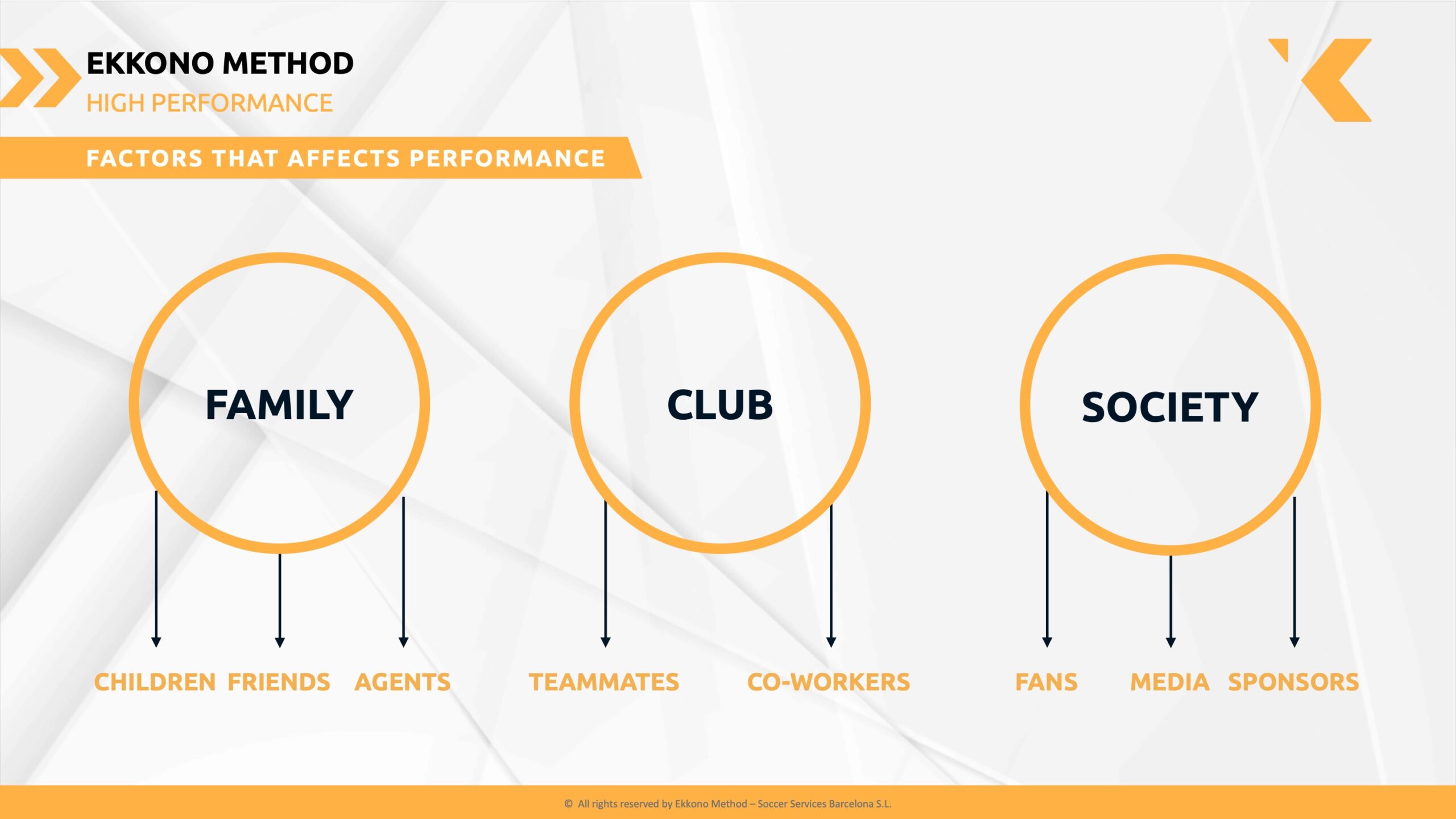
Family situations, agents, social media exposure, and external expectations all affect emotional stability and focus. Inside the club, relationships with teammates, staff members, and the institutional environment shape daily behavior. Outside the club, fans, media, and sponsors add another layer of pressure.
Ignoring these contextual factors limits performance. High Performance coaching requires awareness of the environment in which players live and compete, not only what happens on the pitch.
High Performace
An example of factors that affects performance of a football player.
Stability, Habits, and Planning in Performance Stages
In demanding competitive stages, stability becomes a competitive advantage. Stability is not rigidity. It is created through habits that provide confidence and clarity.
Planning plays a key role here. Weekly microcycles, training schedules, and assessment moments help players and staff understand what is expected and when. Physical data, match statistics, and performance indicators support decision-making, but only when they are integrated into a coherent plan.
High Performance teams use planning to reduce uncertainty, not to control every detail.
“LEARNING DOES NOT EMERGE ONLY FROM REPETITION. WHILE ROUTINES ARE NECESSARY, PERFORMANCE ENVIRONMENTS ALSO NEED SURPRISE.”
Learning, Surprise, and Performance
Learning does not emerge only from repetition. While routines are necessary, performance environments also need surprise.
Surprise activates attention, generates emotions, and enhances learning. When training becomes too predictable, engagement decreases. When everything is chaotic, confidence disappears.
High Performance is achieved by balancing routine and surprise. Coaches must know when to maintain structure and when to intentionally break it to stimulate learning and adaptation.

High Performace. Arteta Surprise
In 2024, Mikel Arteta secretly hired a team of professional pickpockets to target his players during a team dinner. This surprise was designed to deliver a powerful message about situational awareness.
From Linear Models to a Holistic Perspective
Traditional football environments have often relied on linear models. Repeat the same actions, repeat the same exercises, and expect improvement.
However, performance is complex. Players adapt to dynamic situations, not isolated repetitions. Maximum performance is reached when learning processes consider the systemic and holistic nature of the game.
Balancing structured processes with adaptability allows teams to respond effectively to changing game scenarios and competitive demands.
What Coaches Need at the Performance Stage
At a certain point in a coach’s career, technical and tactical knowledge is no longer enough. Performance environments demand decision-making under pressure, clarity in communication, and the ability to manage people and processes.
Coaches must understand how training content changes at performance stage, how to connect analysis with planning, and how to manage learning in competitive contexts. They also need to align staff members and players around shared principles.
High Performance coaching is about leading systems, not just sessions.
Introducing the Expert in High Performance Course
If these challenges define your daily coaching reality, the Expert in High Performance course is designed to support that step forward.
This program guides coaches working from late specialization (U17) to U19 and first teams through the key areas that define High Performance football: analysis, planning, methodology, and management.
Across nine sessions and more than twelve hours of live content, coaches build a complete High Performance framework. The course focuses on understanding performance demands, structuring training and microcycles, designing methodology for competitive contexts, and managing players and staff in demanding environments.
By the end of the course, you will not only understand how High Performance teams operate, but also how to apply these principles directly to your own teams and daily work.
Conclusion: Building Sustainable Performance
High Performance football is not about short-term success. It is about building environments where players and teams can consistently perform at their best level over time.
This requires clear principles, strong methodology, and a shared professional vision. Coaches who invest in understanding performance holistically are better prepared to lead in competitive stages and to adapt to the evolving demands of the game.
Sustainable performance starts with structured thinking, intentional planning, and the courage to go beyond results.