Introduction
When building a game model, a key structural decision shapes everything that follows: should we constantly adapt to the opponent, or develop a strong identity that turns the team into a specialist in specific moments of the game?
The FC Bayern Munich of Vincent Kompany has made its position quite clear as we saw in their recent UEFA Champions League tie against Real Madrid CF.
Against a team with outstanding individual talent, Bayern maintained competitive consistency across both matches. They did not try to dominate every phase of the game. Instead, they focused on maximizing the moments where they could create the greatest advantage. This is not a random choice, it is a methodological one.
Kompany is building a team that does not aim to be complete in every aspect, but highly efficient in specific contexts. That specialization, combined with individual quality, raises the overall team performance.
For coaches, the implication is clear: it is not about accumulating resources, but about prioritizing. Define precisely in which moments of the game your team must dominate, and build everything around that.
Next, we will break down the key points Kompany has used to build this game model.
High Pressing and Defensive Recovery
Bayern applies an individual-oriented high press in the opposition half. With a physically strong squad, they often gain an advantage in one-vs-one duels.
This type of defensive approach naturally increases the probability of regaining possession. However, it also carries risk. If the opponent manages to break the pressure, either through structured build-up or by finding far-side players and winning second balls, they can create situations with significant space and advantage.
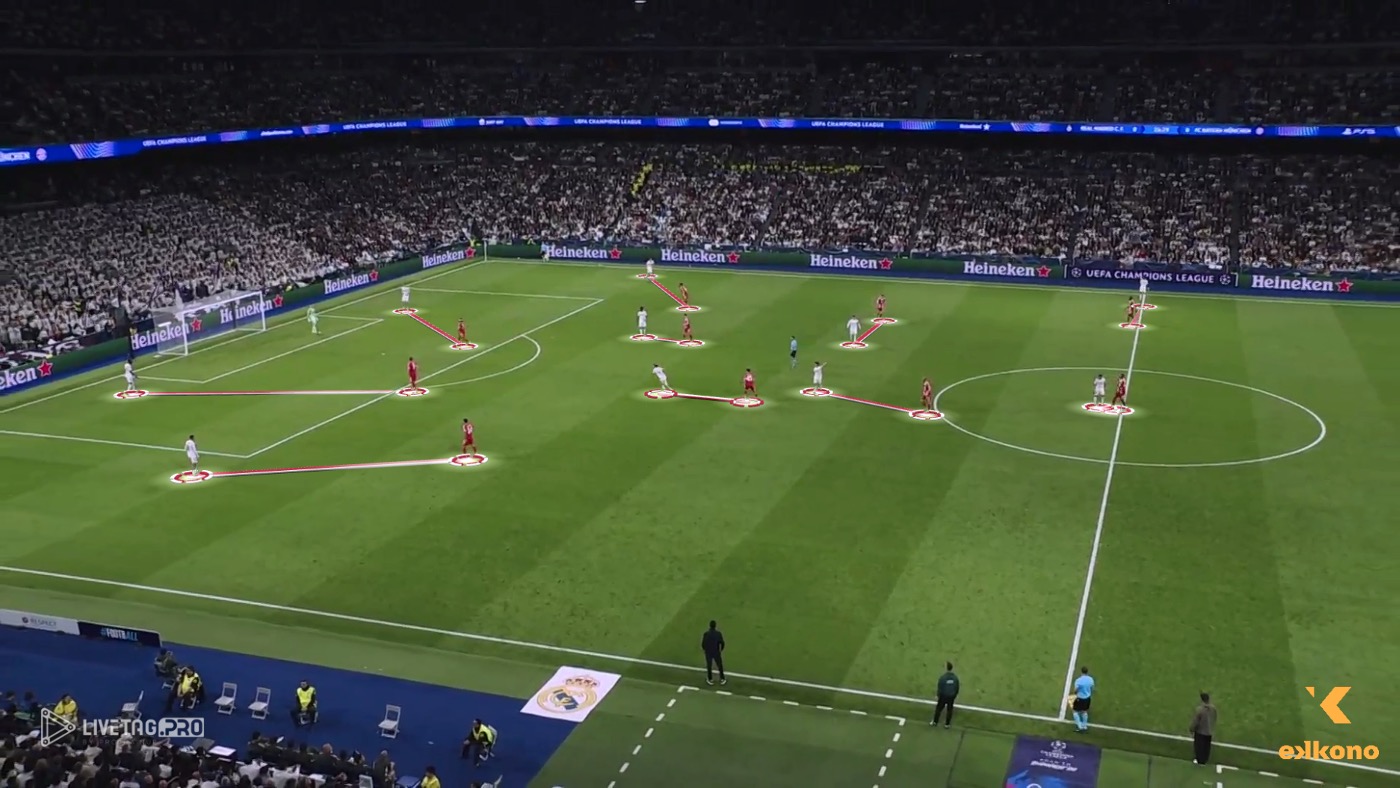
Kompany Bayern: High Pressing Structure
Bayern press Real Madrid high using duel-oriented pressing.
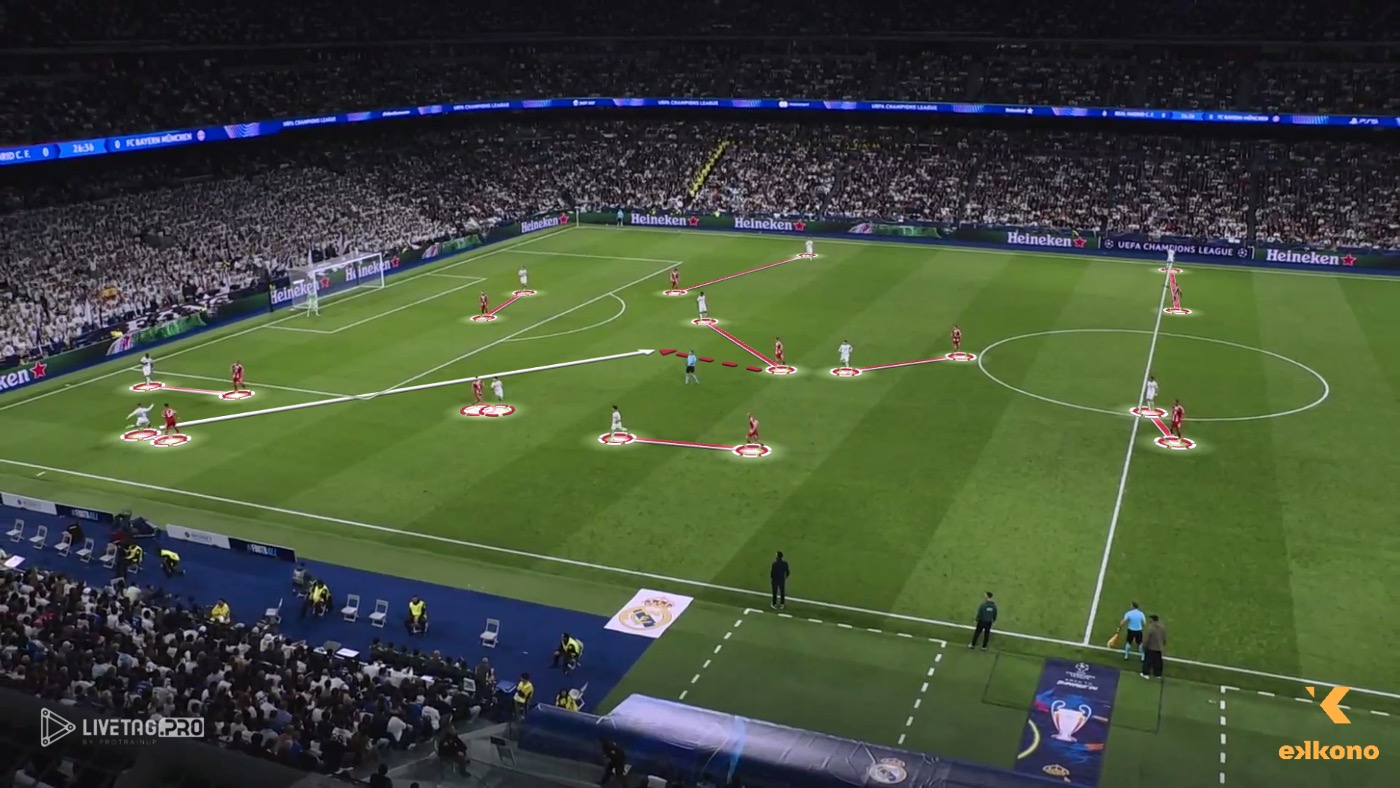
Kompany Bayern: High Pressing Structure II
This pressure forces a mistake, creating a dangerous situation near Real Madrid’s goal.
This is where another key element of Vincent Kompany’s FC Bayern Munich becomes critical: defensive recovery.
When the press is broken, players from the already bypassed lines immediately react by recovering their positions. The team quickly rebuilds a compact block around the ball, aiming to create numerical superiority in the immediate zone of play. This collective reaction reduces the opponent’s advantage and stabilizes the defensive structure.
This mechanism has a direct impact on team confidence. Players can commit forward aggressively in the press, knowing that if they are bypassed, there is a clear and coordinated fallback solution to protect the goal.
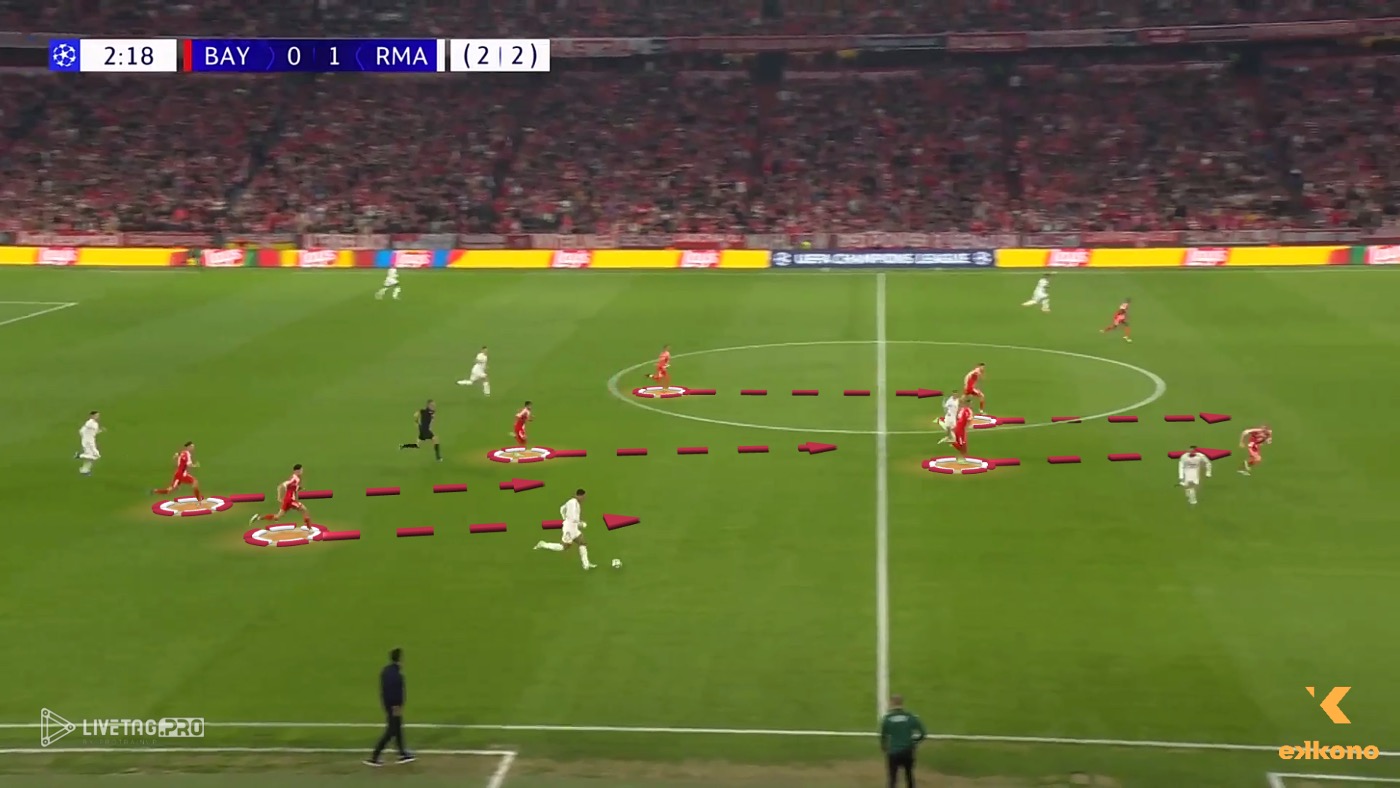
Kompany Bayern: Defensive Recovery I
When Real Madrid break the press, Bayern players immediately recover their defensive positions.
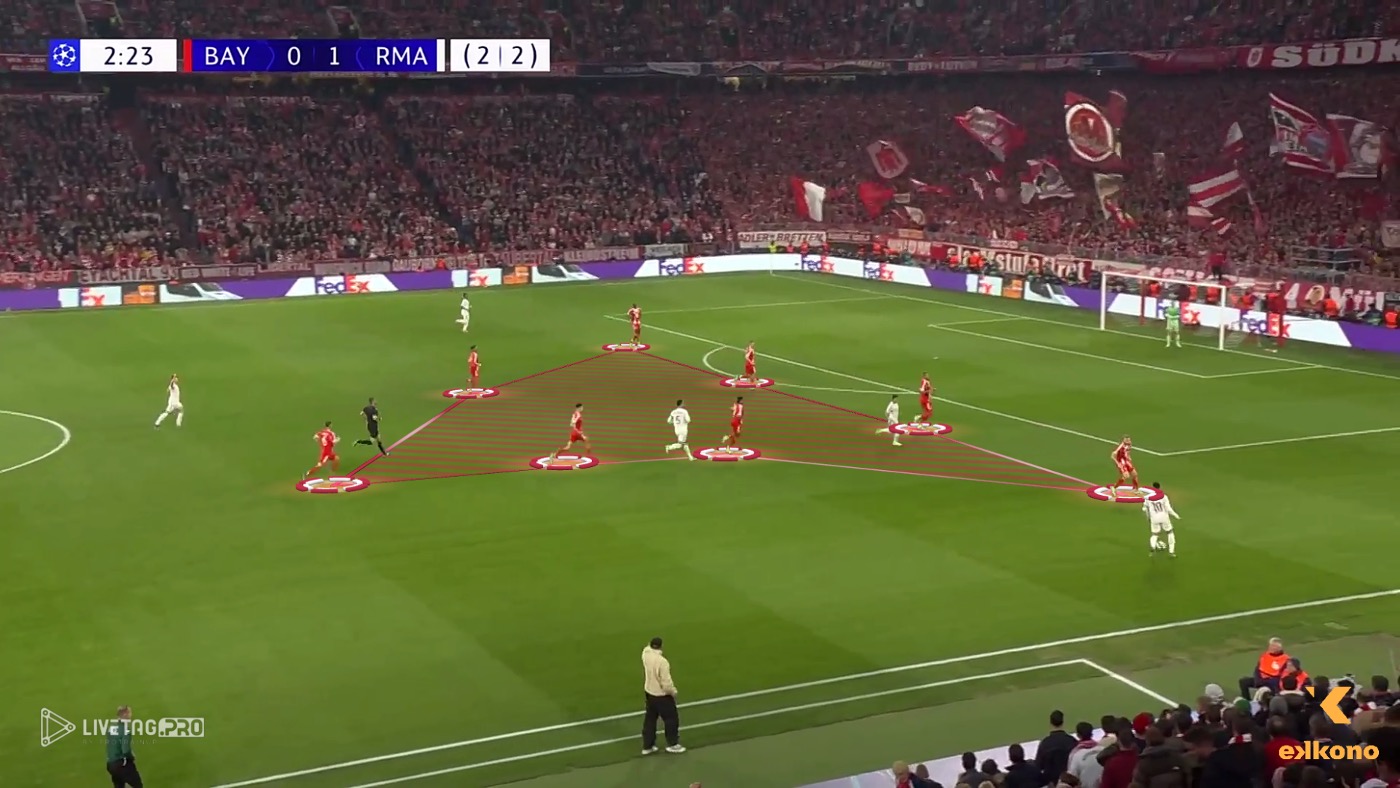
Kompany Bayern: Defensive Recovery II
Bayern reorganize quickly into a compact defensive block.
It is also worth highlighting the collective commitment of attacking players. Profiles like Harry Kane or Michael Olise consistently track back and contribute defensively, even recovering deep into their own penalty area when required.
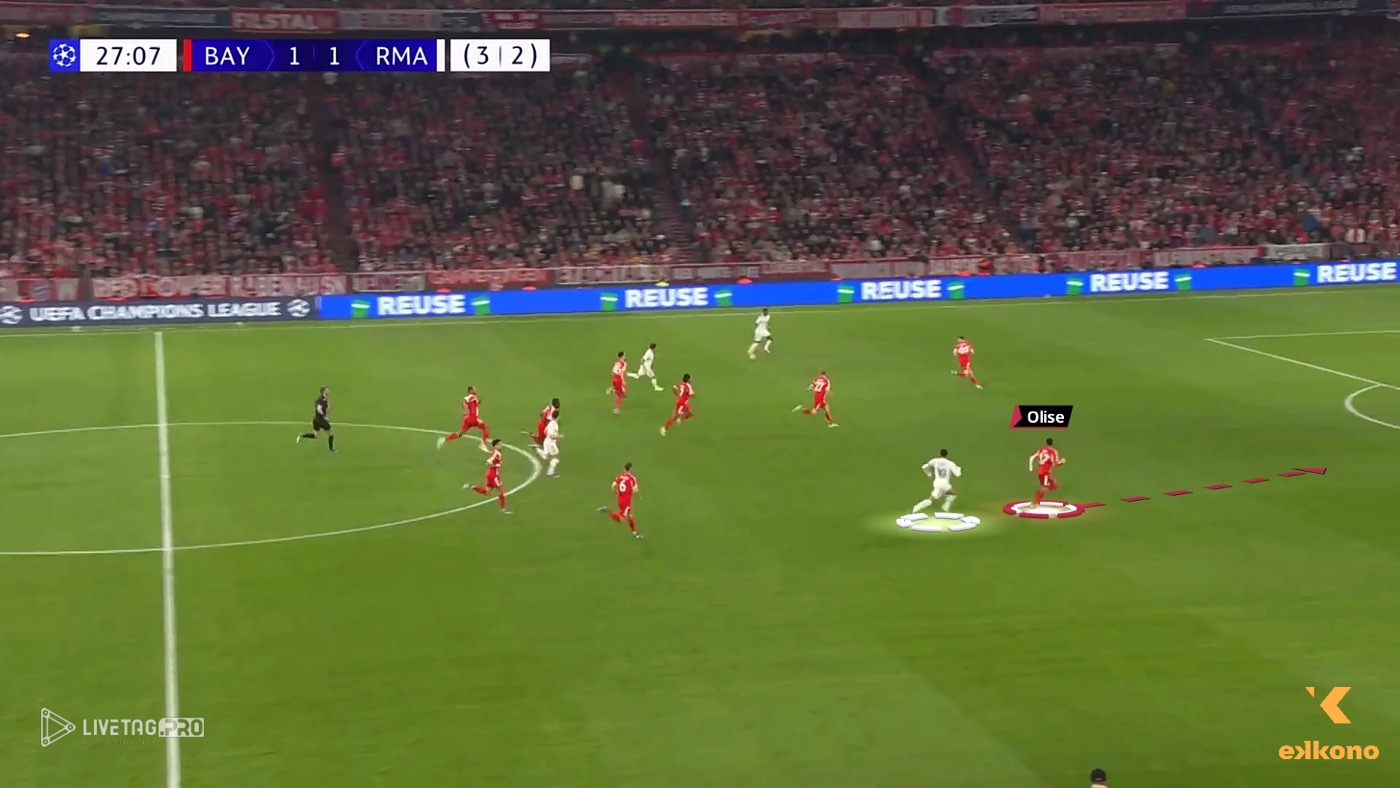
Kompany Bayern: Player Profile I
In this example, Olise tracks back to follow Mbappé.
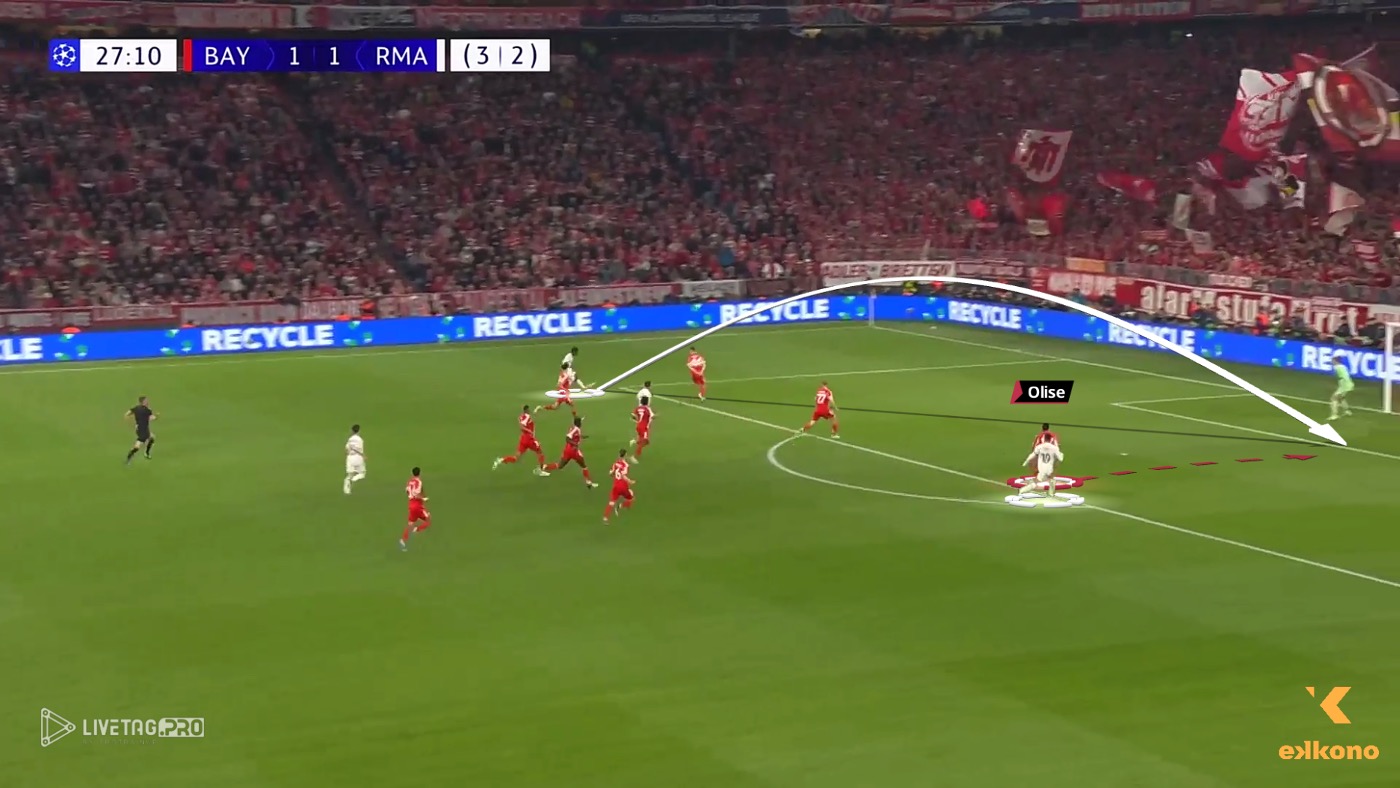
Kompany Bayern: Player Profile II
Olise continues the defensive action until the end inside the box.
Proactive Medium Block: Compactness and Forward Defending
Bayern is a team that wants to defend forward. However, they also recognize that in modern football, giving away too much space can quickly become dangerous. That is why, when immediate high pressing is not possible, they first establish a compact structure and then look to progress forward from that base.
The medium block is not passive. It is proactive. Once the structure is set, players look for the right moment to step forward and apply pressure, rather than waiting deep.
There is also a clear behavioral detail in the defensive line. Opponents are not allowed to receive between the lines without pressure. Defenders are ready to step out aggressively to contest those situations. At the same time, if the ball carrier has time and space, they anticipate the possibility of runs in behind. This creates a more flexible line, avoiding the excessive rigidity seen in teams like FC Barcelona, while still maintaining the intention to defend forward.
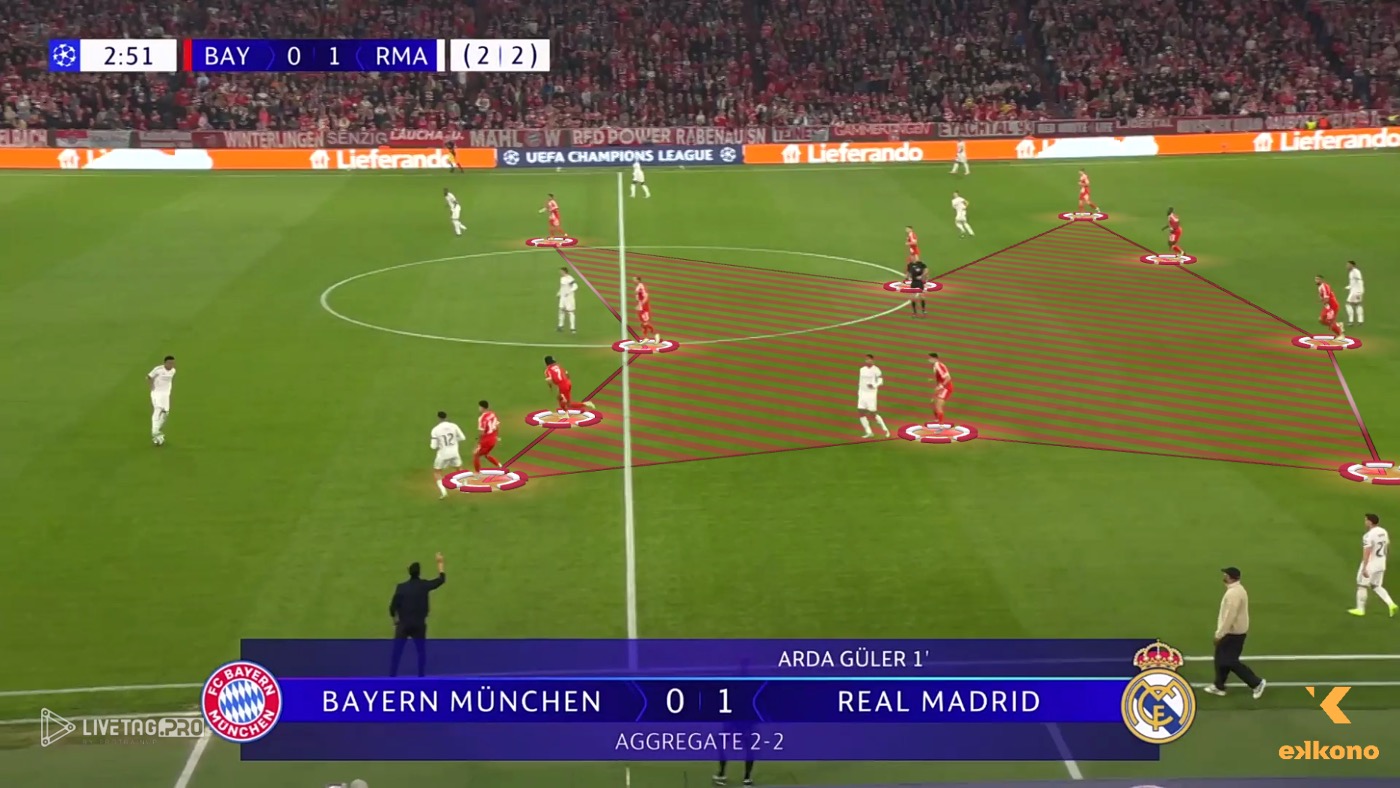
Kompany Bayern: Proactive Medium Block I
Bayern defend in a compact medium block.
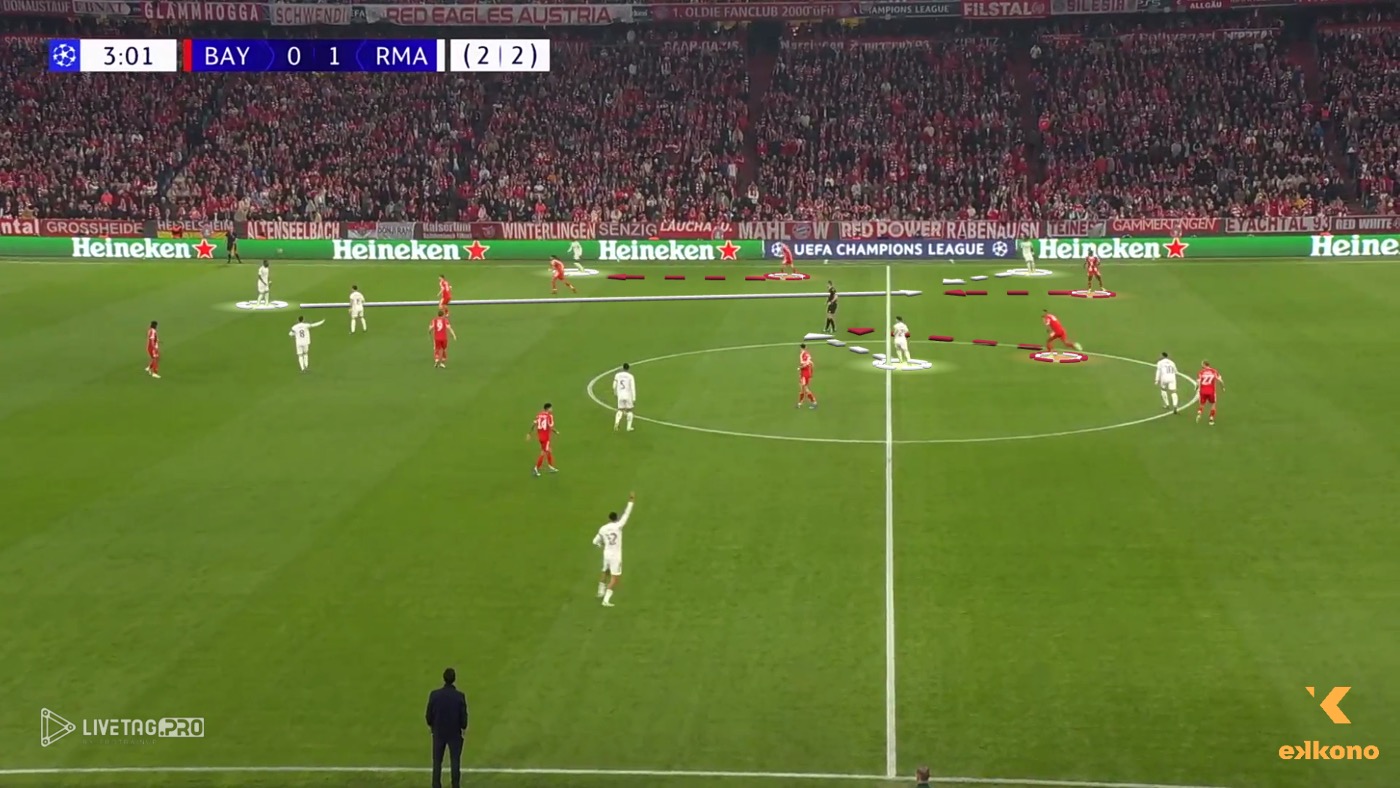
Kompany Bayern: Proactive Medium Block II
When Rüdiger (CB) plays a pass between the lines, Bayern’s centre-backs Tah and Upamecano step out aggressively to track their opponents.
Positional Attack Structures
It is clear that Bayern is an associative team. However, in the build-up phase, especially against high pressure, they often look to play towards far-side players to avoid unnecessary risk in central areas.
In positional attack, though, we see a team with multiple structures and well-developed ideas:
1. Kane and the variation of behaviors
The team’s structure changes significantly depending on the positioning of Harry Kane. At times, Kane drops deeper to create numerical superiority in midfield, allowing other players to attack the space if defenders follow. In other situations, Kane stays higher and pins the opposition center-backs, enabling midfielders to occupy advanced spaces. When Kane fixes the center-backs, the team often organizes in a 3-4-3 structure.
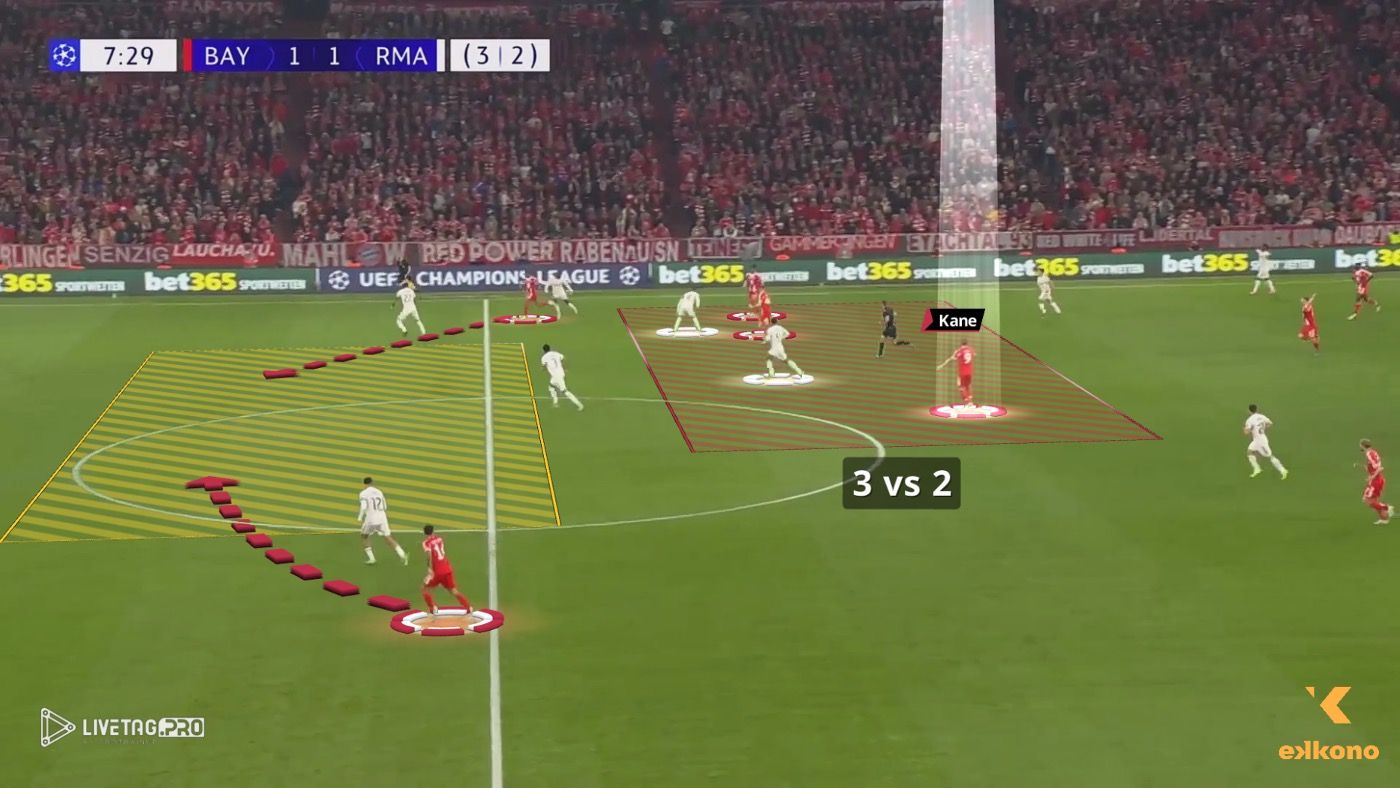
Kompany Bayern: Positional Attack Structures I
Kane drops into midfield to create numerical superiority and free space for teammates.
2. Attacking the half-spaces
Full-backs play a key role here. Whether in a 3-4-3 or a 4-3-3 with a false nine, they frequently adopt inside positions before attacking the half-spaces. This movement creates instability in the opponent’s defensive structure and opens new passing and progression lanes.
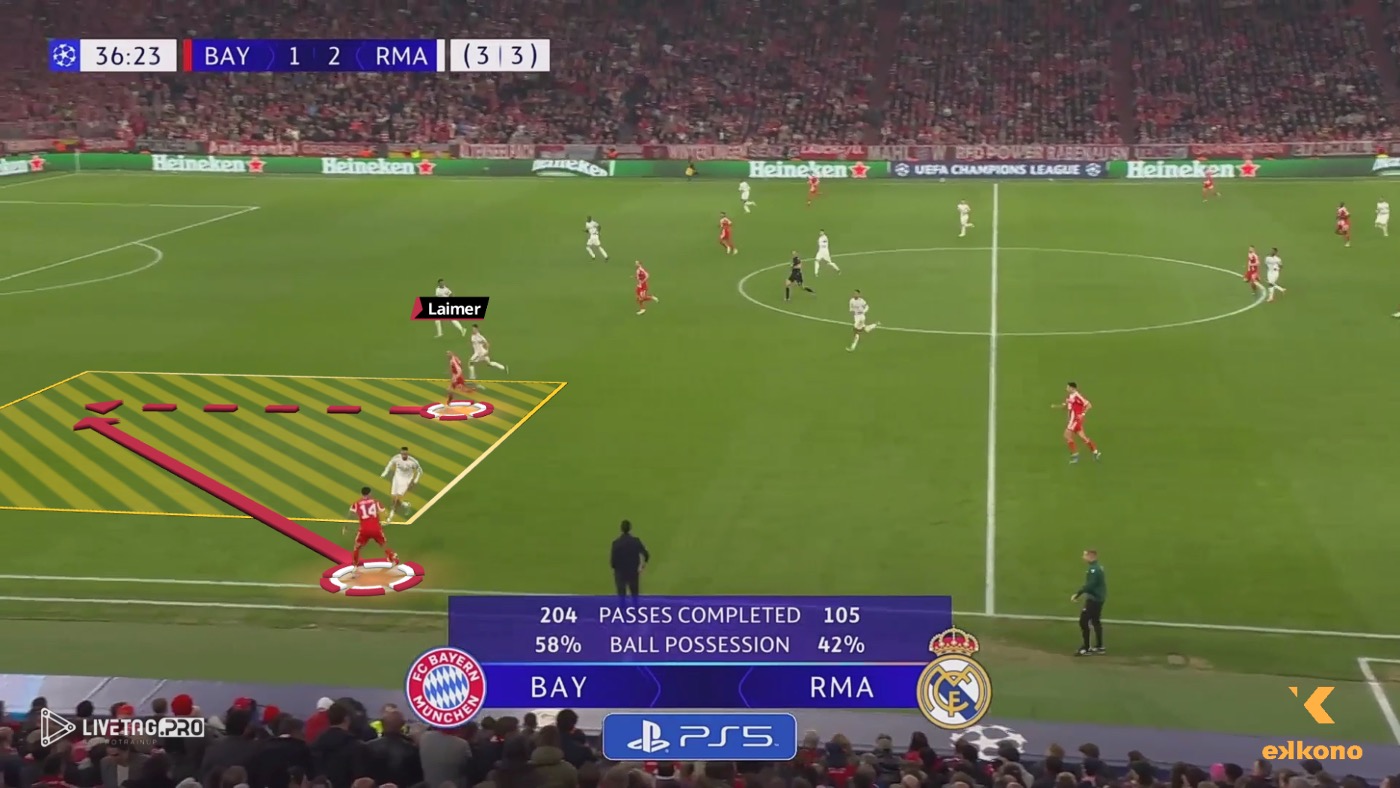
Kompany Bayern: Positional Attack Structures II
Laimer attacks the half-space from his full back position.
3. Switches of play
Another important element is the team’s ability to switch play effectively. This can happen directly, with players like Harry Kane or Joshua Kimmich, or indirectly through associative combinations. When Bayern successfully switches the point of attack, they often find players such as Michael Olise in wide areas with time and space, especially when combined with full-backs attacking inside channels.
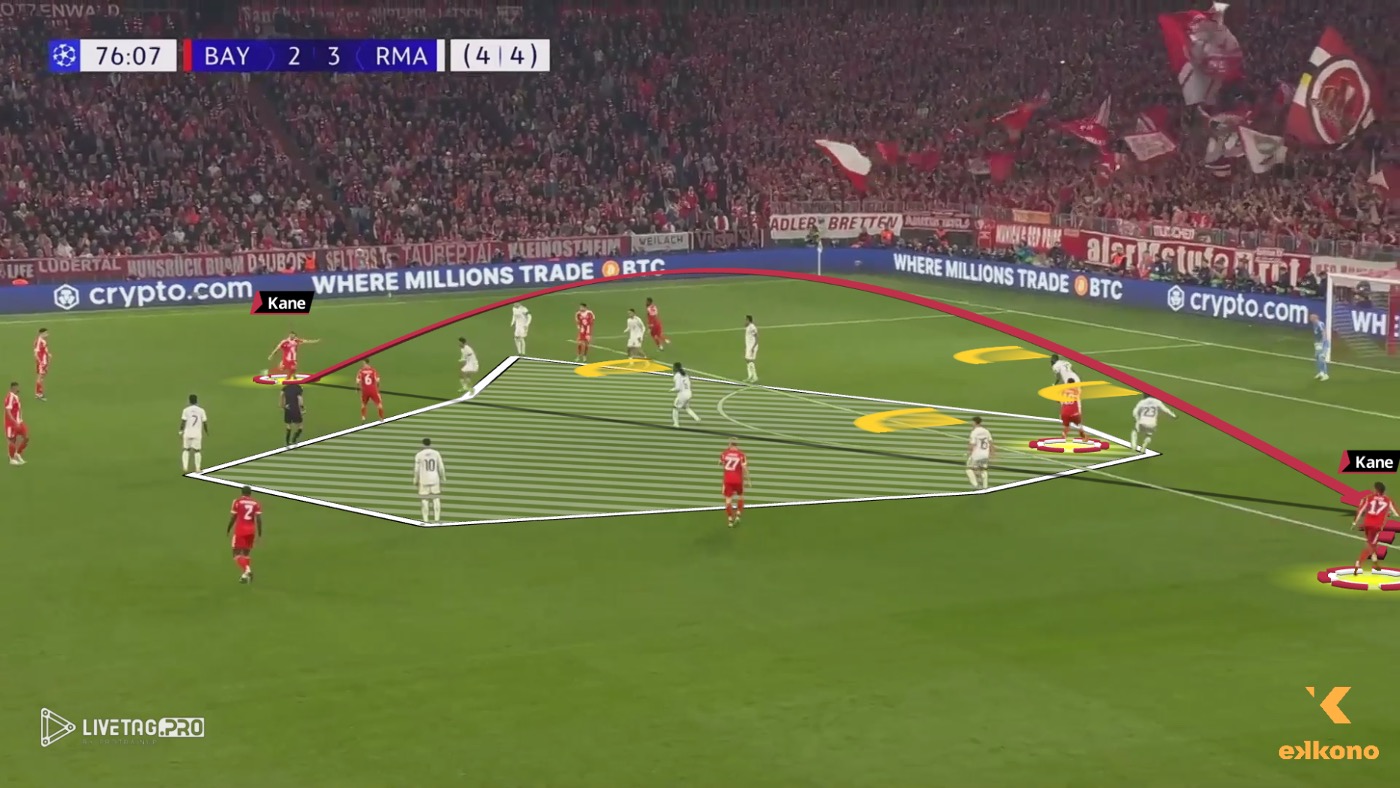
Kompany Bayern: Positional Attack Structures III
Kane switches play to Olise, who receives with time and space.
4. Box occupation and second-ball control
Finally, Bayern consistently attacks the opponent’s box with a high number of players. This aggressive occupation increases their chances of finishing actions and allows them to control second balls more effectively, sustaining attacking pressure and limiting the opponent’s ability to transition.
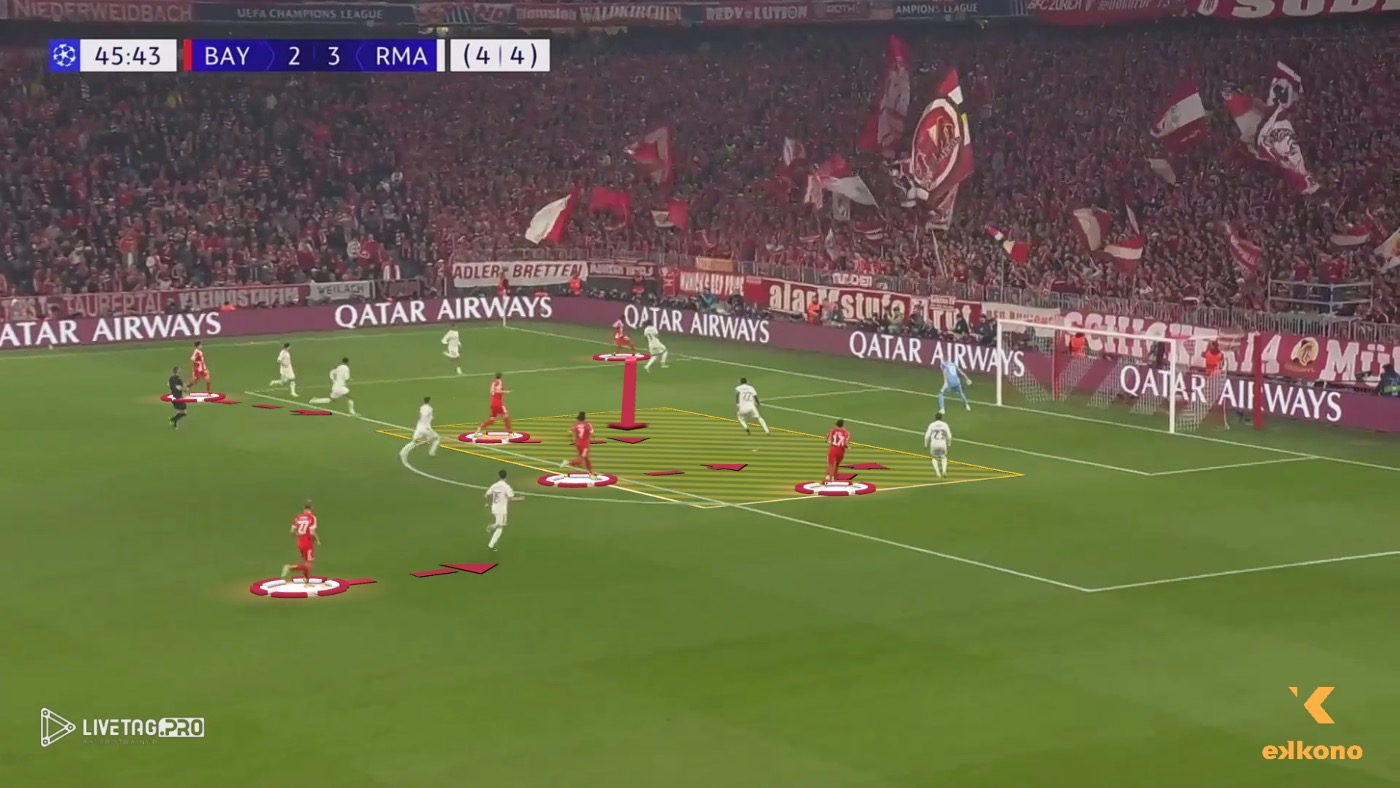
Kompany Bayern: Positional Attack Structures IV
Bayern attack the box with first and second wave players, anticipating second balls.
Defensive Transition: Immediate Pressure After Ball Loss
The final aspect, and one that brings significant performance to Bayern, is their defensive transition, specifically the pressure applied immediately after losing possession.
From the overall analysis, it is clear that this is a key performance factor for Vincent Kompany. It is not occasional behavior, but a trained collective response that requires daily work to reach that level of reaction.
The idea is especially evident in the opposition half. Whenever there is a realistic chance to recover the ball, the team continues to press forward aggressively, even if the opponent has already managed to complete three or four passes.
This persistence in the immediate press limits the opponent’s ability to stabilize possession, increases the probability of regaining the ball in advanced areas, and allows Bayern to sustain attacking momentum with minimal defensive reorganization.
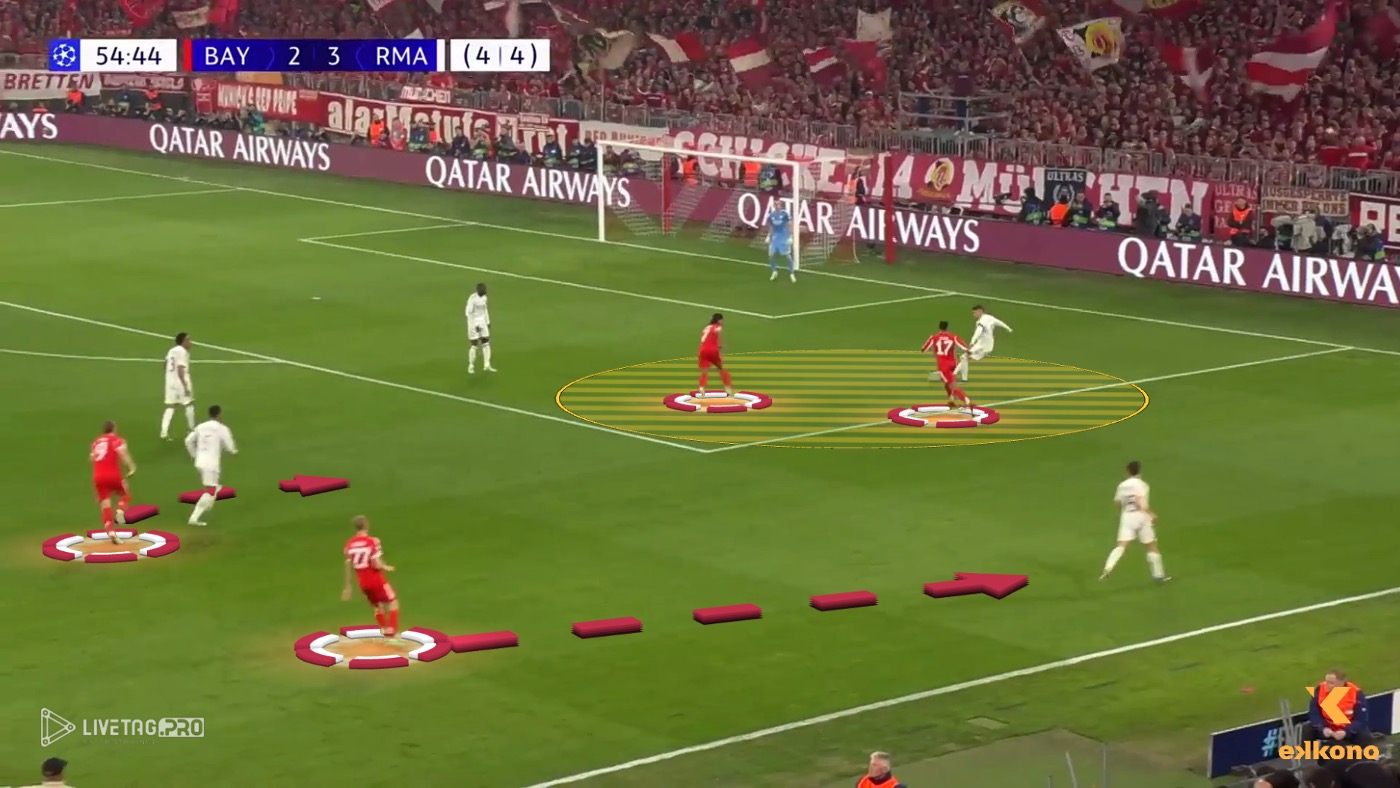
Kompany Bayern: Defensive Transition
Immediately after losing possession, Bayern apply aggressive counter-pressing.
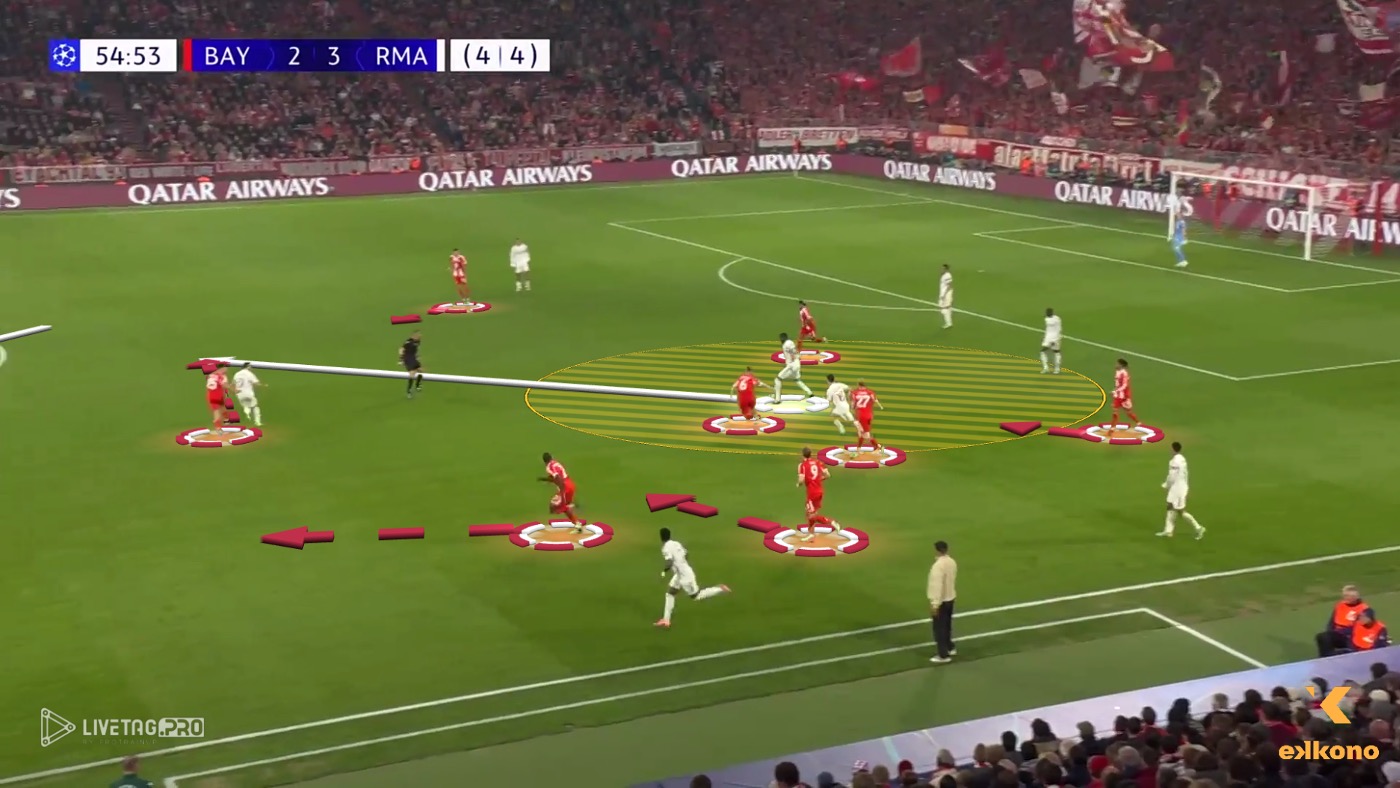
Kompany Bayern: Defensive Transition II
Despite being bypassed, Bayern sustain pressure and regain possession.
Conclusion
Against Real Madrid CF, Bayern could have taken a more conservative approach, especially against players like Kylian Mbappé or Vinícius Júnior, who are among the most dangerous in the world when attacking space. Instead, Bayern remained fully committed to their idea.
At Ekkono, we believe that a game model should build a team that is highly specialized in the moments of the game defined by the coach. It is unrealistic to control every situation. The key is to prioritize and become truly effective in specific contexts.
These collective strengths, combined with individual player development, are what ultimately make the difference in performance and results.
The FC Bayern Munich of Vincent Kompany is a clear and powerful example of this approach.