
The Defensive Identity of Farioli’s Porto
Francesco Farioli’s Porto have been one of the biggest surprises of the season. At this stage, they have conceded the fewest goals across Europe’s top leagues, with just 7 goals allowed.
In the defensive phase, Porto are an aggressive side characterized by full-pitch pressure. They consistently press the ball carrier with intensity, reducing the opponent’s time and space and forcing rushed decisions.
Porto’s base structure is a 1-4-3-3. From there, in the defensive phase, the system adapts to create the most favorable scenarios for the defensive behavior the team aims to implement.
High Press Focused on Duels + Dominance in the Air
In high pressing situations, Farioli selects the system that best allows the team to create individual duels. The most frequent defensive structures are 1-4-3-3, 1-4-2-3-1, and 1-4-4-2. For example, in a recent match against Sporting Club de Portugal, he also used a 1-5-3-2.
Porto aim to generate as many high pressing situations as possible throughout the match. To do so, they seek numerical equality in the area of the pitch where the ball is located:
- Prioritizing central compactness to avoid being outnumbered inside, and initiating the press when the ball carrier begins the passing action with time and space.
- Reducing distances to potential receivers when the ball carrier is already under pressure and has not yet released the pass.
A key factor that sustains this approach is the team’s dominance in aerial duels. When opponents cannot progress through short combinations and opt for a direct pass into a target player, Porto’s center backs and defensive midfielder consistently win a high number of aerial challenges.

Francesco Farioli’s Porto
The advanced midfielder initiates the team press following a backward pass to the center back.

Francesco Farioli’s Porto
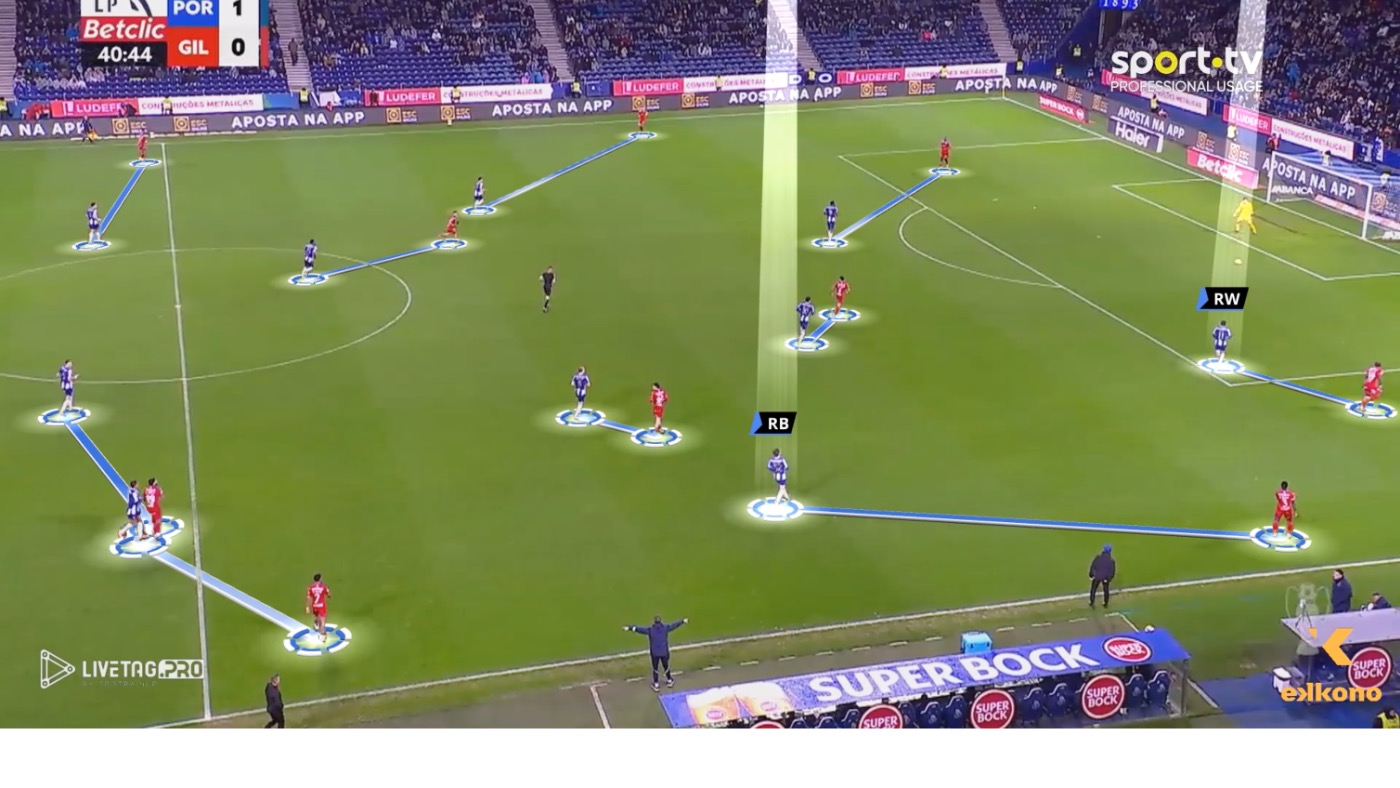
Porto applies an individual pressing approach, with the RW acting as a second striker and the RB stepping out to press the opponent’s left full back.
Narrow Block When the Ball Reaches Wide Channels
Another characteristic of the team is how much they shift when the ball moves to one of the flanks. This allows them to form a very narrow block that is difficult to penetrate and forces the opponent to switch the point of attack to maintain possession.
Since the team prioritizes preventing central progression, many of these switches of play occur outside Porto’s main defensive structure. This often gives them new opportunities to activate high pressing from a mid-block position, again seeking duels.

Francesco Farioli’s Porto
In this example, we can see how Porto overloads the wide channel, closing passing lanes with multiple players.
Defensive Transition to Prevent Counterattacks
Another aspect the team masters is defensive transition. When the opponent regains possession in open or semi-open situations, Porto drop as quickly as possible to rebuild their defensive block behind the ball. The aim is to re-establish pressing triggers and activate high pressure again.
If not all players are able to recover immediately, or if the opponent appears likely to break the midfield line, tactical fouls frequently appear. These actions allow the team to reorganize and prevent the opponent from counterattacking with advantage.

Francesco Farioli’s Porto
In this defensive transition, we can see how Porto quickly forms a compact defensive block after losing the ball..

Francesco Farioli’s Porto
Unable to form a defensive block quickly, the CB commits a tactical foul to stop progression through a free player.
Why This Defensive Model Works
Through these three key principles, Farioli’s Porto consistently keep opponents, and especially the ball carrier, away from the penalty area. Their defensive model is designed to control space before the final third, reducing exposure rather than relying on last-ditch defending.
This approach is particularly strategic, as Porto are not among the most dominant teams in aerial duels inside their own box compared to other elite sides. By preventing deep entries and limiting quality delivery into the area, they protect their potential weaknesses through collective structure and proactive defending.