
Introduction
In modern football, teams often defend deep in their own half using a low block. This choice can result from the opponent’s quality, the match context, or a clear tactical plan. When space is limited and pressure is high, the low block becomes a key tool to protect the goal.
Low block defending relies on compactness near the penalty area, strong central density, and clear control of crosses and second balls. Unlike a mid-block, the objective is not to press high. The priority is to protect dangerous zones close to the box and reduce the quality of scoring chances. To be effective, the low block must stay well organized and connect with the ability to counterattack when opportunities appear.
Defend Outside the Box and Protect the Box
One of the key principles of low block defense is to defend outside the box whenever possible. The objective is to stop the opponent before they enter the penalty area, where chances become more dangerous. By protecting the space in front of the box, the team forces the opponent to shoot from distance or play wide.
When the ball moves to the flanks or a cross is about to arrive, defenders must drop into the box quickly. They need to protect key zones, mark attackers, and control the penalty spot. They must also be ready to attack second balls. Effective low block defending requires patience, good timing, and strong coordination between the defensive line and the midfield.
Clearing the ball is a priority, especially under pressure. Defenders should avoid central areas and clear diagonally or aerially to reduce immediate danger. After each clearance, the team must reorganize quickly and control the defensive line. Protecting the box is not a single action. It is a continuous defensive process.

Low-Block Defense outside the box
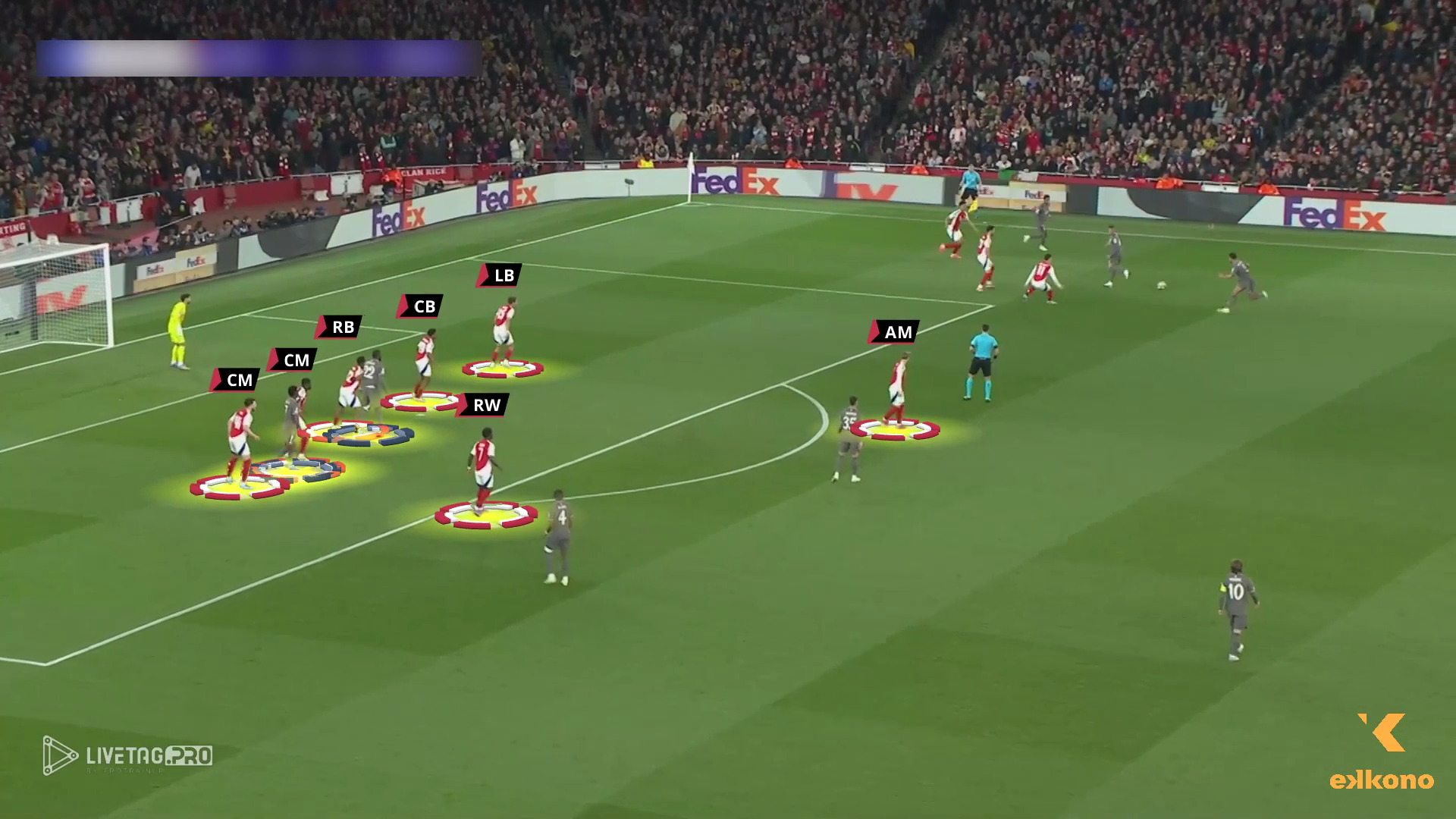
In this play, Arsenal defend outside the box with a flat defensive line, keeping the opponent in an offside position.
Low-Block Defense to protect the box
Here, as Real Madrid attack from the flank, Arsenal drop inside the box to apply individual marking and protect key zones.
Defend the Flanks and Maintain Central Balance
Many teams try to break a low block by creating overloads on the flanks. For this reason, teams must define clear principles for defending wide areas while maintaining central balance. The main priority always remains the protection of central spaces in front of goal.
Defending the flanks does not always require aggressive pressing. Depending on the situation, the team may press the ball, delay the opponent, or allow a wide pass while protecting the box. These decisions must be collective and well coordinated to avoid opening gaps between defenders.
Fullbacks, wingers, and central midfielders play a crucial role in this phase. They must communicate constantly to manage overlaps, underlaps, and switches of play. While players apply pressure on the ball, enough teammates must remain inside the box. They need to defend crosses, cutbacks, and second balls. A balanced low block allows teams to defend wide attacks without losing control of the center.
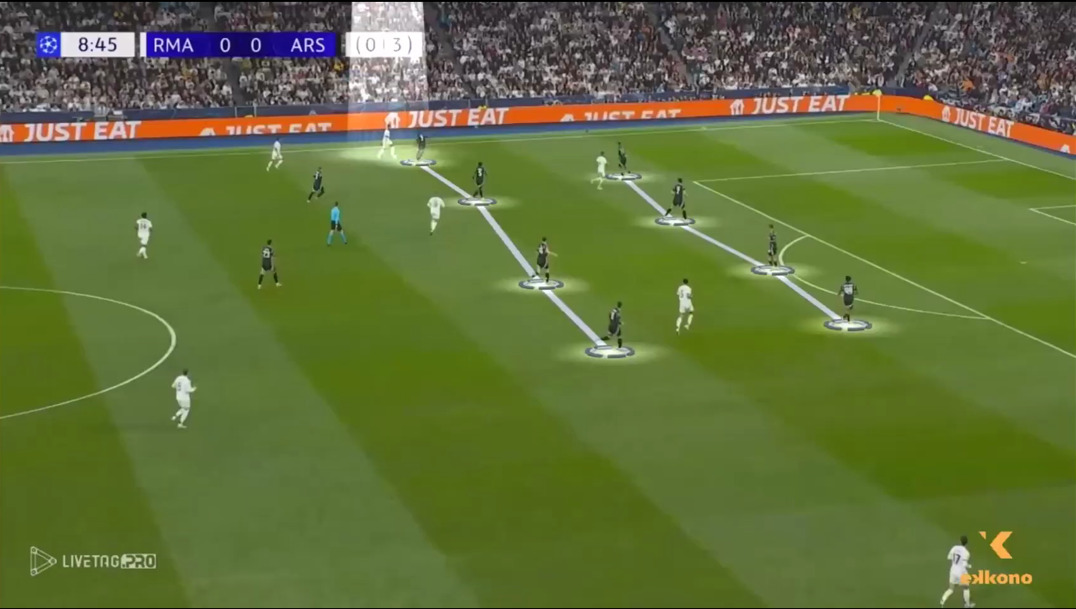
Low-Block Defense for defend the flanks
In this action, RW Saka applies pressure on the opposite LW Vinicius, helping the low block stay compact and centrally balanced.
“A WELL-ORGANIZED LOW-BLOCK IS NOT ABOUT DEFENDING DEEP, BUT ABOUT PROTECTING THE BOX, CONTROLLING SPACE, AND BEING READY TO COUNTERATTACK”
Prepare the Counterattack
Low block defense is not only about protecting the goal, but also about preparing the counterattack. Before the match, teams must clearly define how many players will stay forward and who is responsible for attacking the space once possession is regained.
Usually, this includes a target player who can hold the ball and one or two players ready to run behind the opponent’s defensive line. These players must stay connected to the team and constantly adjust their positioning to offer clear passing options.
When the ball is recovered, the first pass is crucial. The ball carrier must quickly identify the best option based on the risk-benefit balance. If the counterattack is on, players must attack with speed and clarity. Even when the counterattack is not possible, keeping players high helps the team push the block up and avoid defending deep for too long.
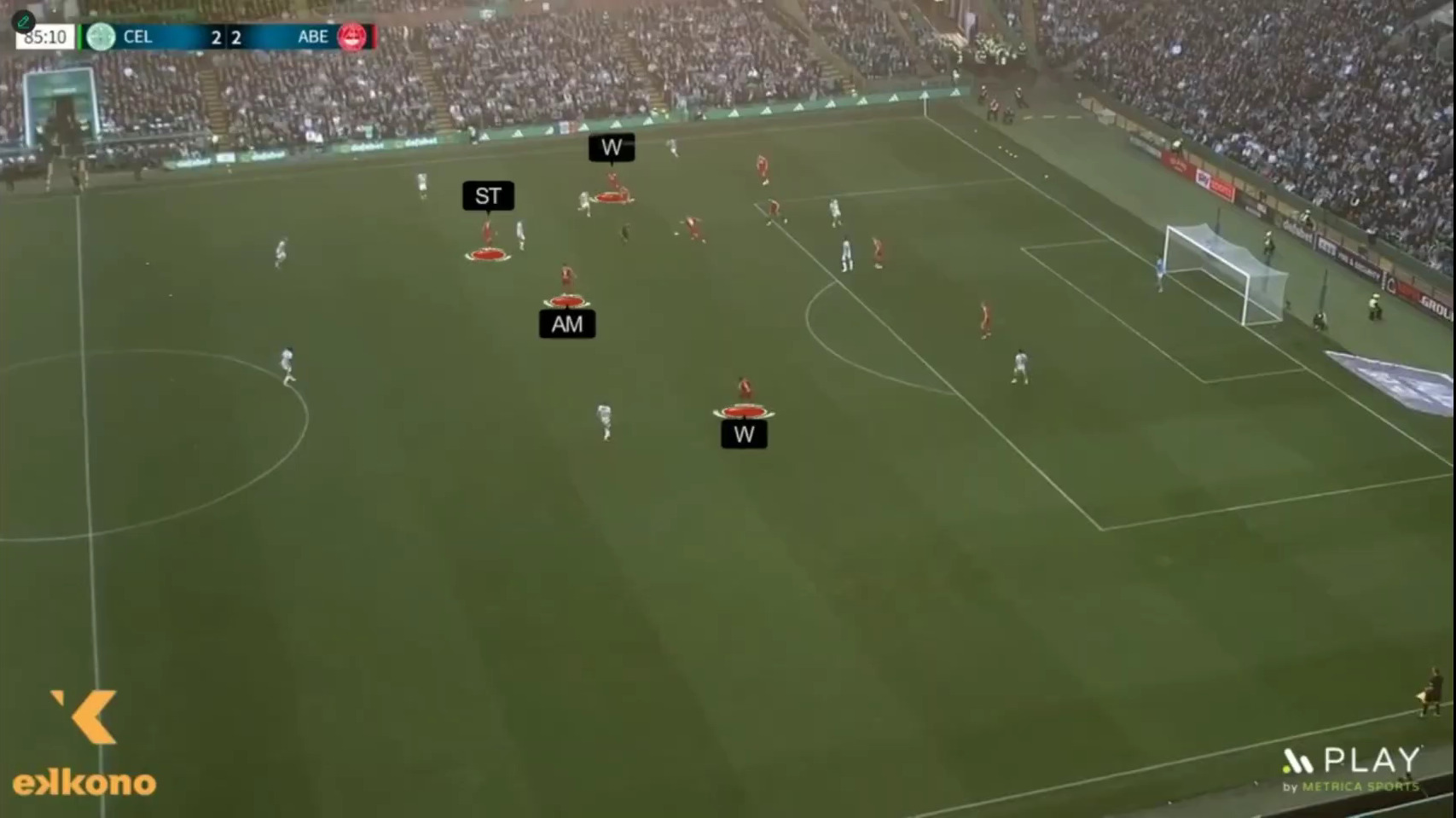
Low-Block Defense to prepare the counterattack
After recovering the ball, the midfielder initiates the counterattack while the wingers, striker, and attacking midfielder run into space.
Conclusion
Low block defense is a demanding but highly effective tactical strategy in modern football. When teams defend outside the box, protect key zones, control the flanks, and prepare the counterattack, they can limit the opponent’s attacking options and stay competitive for long periods of the match.
Mastering the low block is not about defending deep without purpose, but about making smart collective decisions. A well-organized low block allows teams to absorb pressure, protect the box, and turn defensive moments into attacking opportunities. In today’s game, low block defending is not a weakness, but a sign of tactical maturity.