
Introduction
Kjetil Knutsen’s Bodø/Glimt has been one of the breakout teams of the 2025–26 Champions League, reaching the Round of 16 and emerging as one of the sensations of the competition.
During the group stage, before the end of the year, they managed to draw against teams such as Tottenham and Borussia Dortmund. However, the biggest surprises came in 2026. First in the group stage, securing victories against Manchester City and Atlético de Madrid. Then in the Round of 32 tie against Internazionale Milano, the finalist of the previous Champions League edition. Bodø/Glimt won 3–1 in the first leg and 1–2 in the second leg.
These performances reflect the clarity of Bodø/Glimt’s collective structure and the strong tactical principles behind their game model.
In this tactical analysis, we will explore some of the key aspects that define their style of play, using the games against Inter as a reference to illustrate several of the mechanisms that allowed them to create advantages.
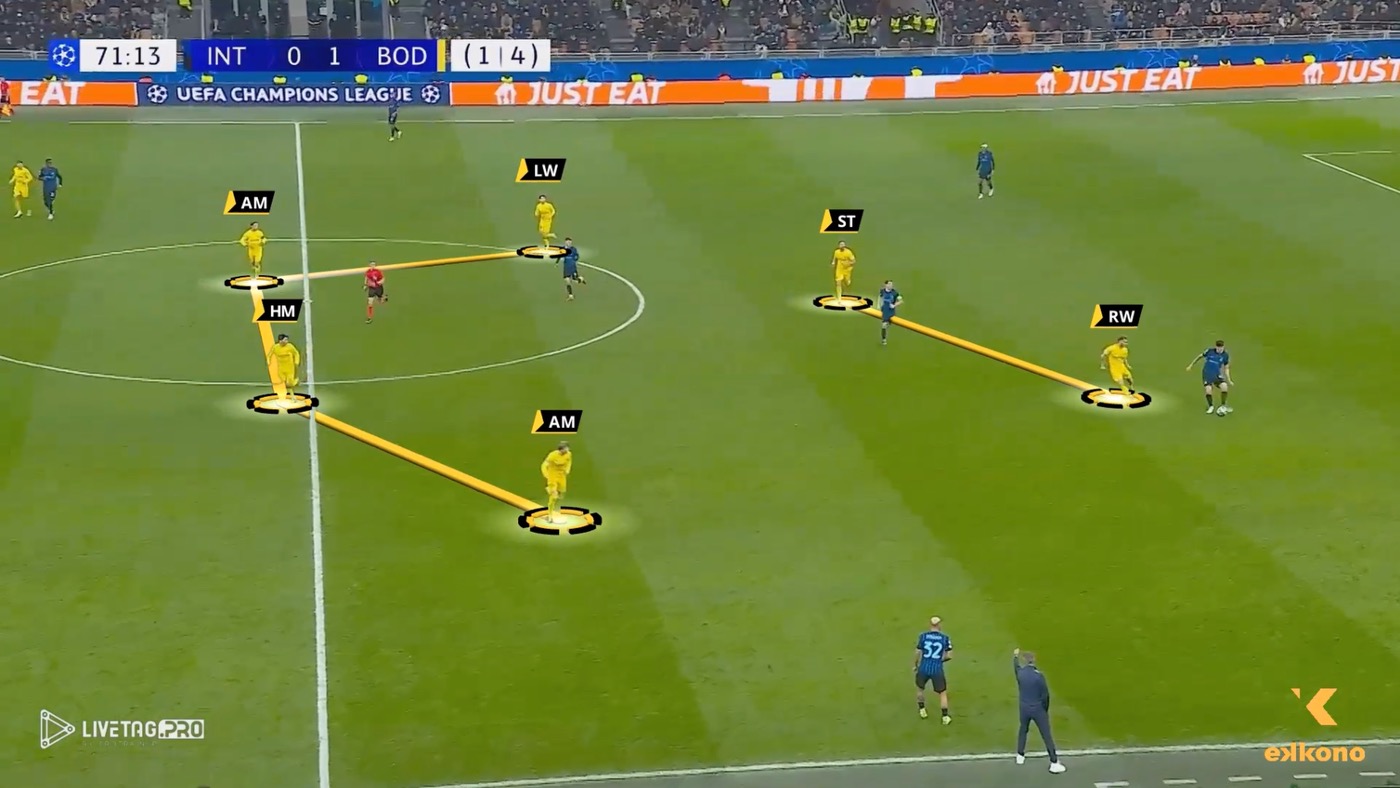
To begin, it is useful to contextualize the formations used by both teams. Inter, as they have done in recent seasons, played with a 1-3-5-2 in attack, which transformed into a 1-5-3-2 in defense. Bodø/Glimt used a 1-4-3-3 in attack and a 1-4-4-2 in defense.
Progressing on the Same Flank by Mobilizing the Attack
In the first leg, when Bodø/Glimt had possession in the opponent’s half, they frequently directed the ball toward the wings and placed at least four players around the ball zone. From there, they used two main strategies to break the opponent’s block.
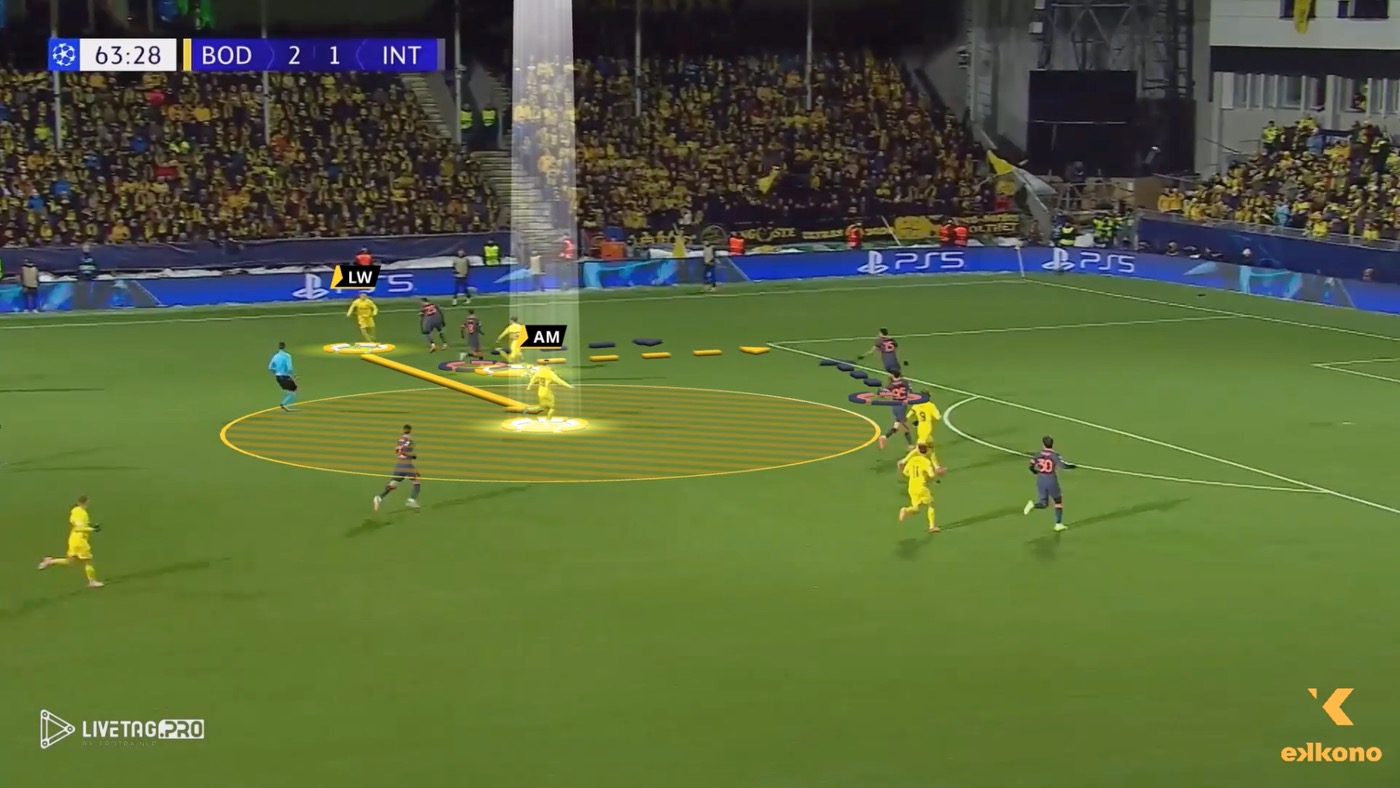
When Bjørkan or Hauge had the ball on the left wing, or Sjøvold or Blomberg on the right wing, the team often connected the movement of two players. The player positioned in the nearest pocket made a channel run, forcing Inter’s first center-back to follow. At the same moment, another player appeared further away in front of that center-back. This made it very difficult for the central defender in the middle of the back three to step forward and apply pressure in time.
Knutsen’s Bodø/Glimt
The left winger receives the ball as two teammates attack the same flank. One makes an unmarking movement, while Fet (AM) receives the ball with an advantage.
Short Switches of Play to Find the Far Fullback
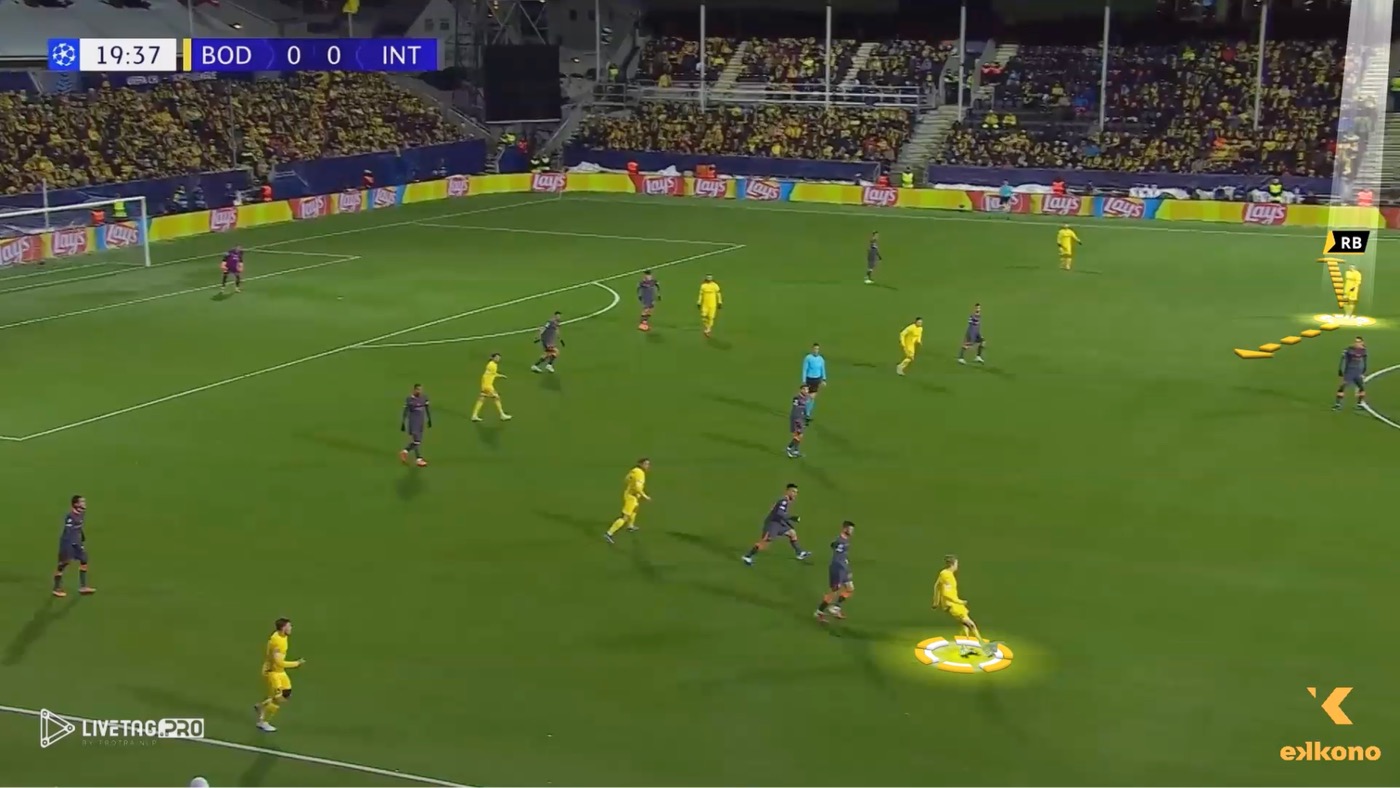
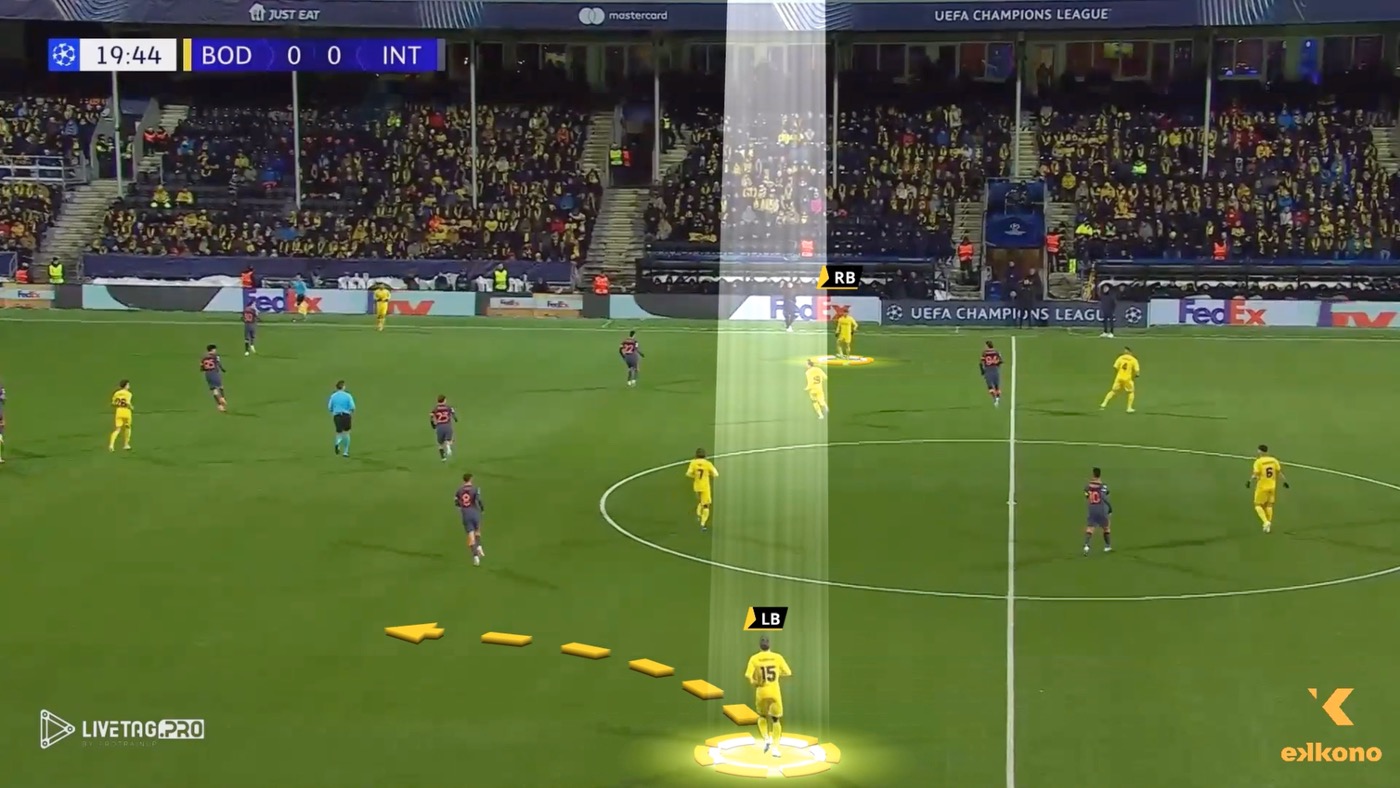
When Inter shifted across with their three midfielders, space opened in the half space on the opposite side. This created the right conditions for a short switch of play to bypass the midfield line and find the far fullback, who was prepared to receive inside.
Fullbacks Bjørkan and Sjøvold interpreted this hybrid zone very well, allowing them to support both inside and outside depending on the situation.
The team could have generated even more advantage if they had used switches of play through the midfielders more frequently. Most of these switches were instead made through the center-backs. The first goal of the tie is a clear example of the strategy used to find the far fullback with an advantage and break Inter’s midfield line.
Knutsen’s Bodø/Glimt
Sjövold (RB) occupies a hybrid position, allowing him to receive either centrally or in the wide channel.
Knutsen’s Bodø/Glimt
When the RB receives the ball, Bjorkan (LB) moves inside to surpass the opponent’s midfield line.
Block Defense Followed by Offensive Transition
Another key aspect in both matches was defending in a block and immediately attacking through offensive transitions. This allowed Bodø/Glimt to connect with players in the next line with one or two passes and progress toward goal with an advantage.
To transform their 1-4-3-3 into a 1-4-4-2, Blomberg (right winger) moved into the right striker position alongside Høgh (center forward). At the same time, Hauge (left winger) dropped to the midfield line. Fet (left advanced midfielder) and Berg (central midfielder) formed a double pivot, while Evjen (right advanced midfielder) shifted toward the right wing.
At times, due to the team’s attacking dynamism, players ended up occupying different positions than their starting roles. As a result, players assumed the defensive responsibilities of the positions they were occupying at that moment.
Knutsen’s Bodø/Glimt
Defensively, Bodø/Glimt shift from a 1-4-3-3 to a 1-4-4-2 with positional rotations.
At the moment of ball recovery, the second striker played an important role in breaking Inter’s midfield line. This forced Inter to defend by running backward and toward the center, leaving open spaces on the outside. That allowed the wingers to receive with an advantage and attack the spaces behind the defensive line.
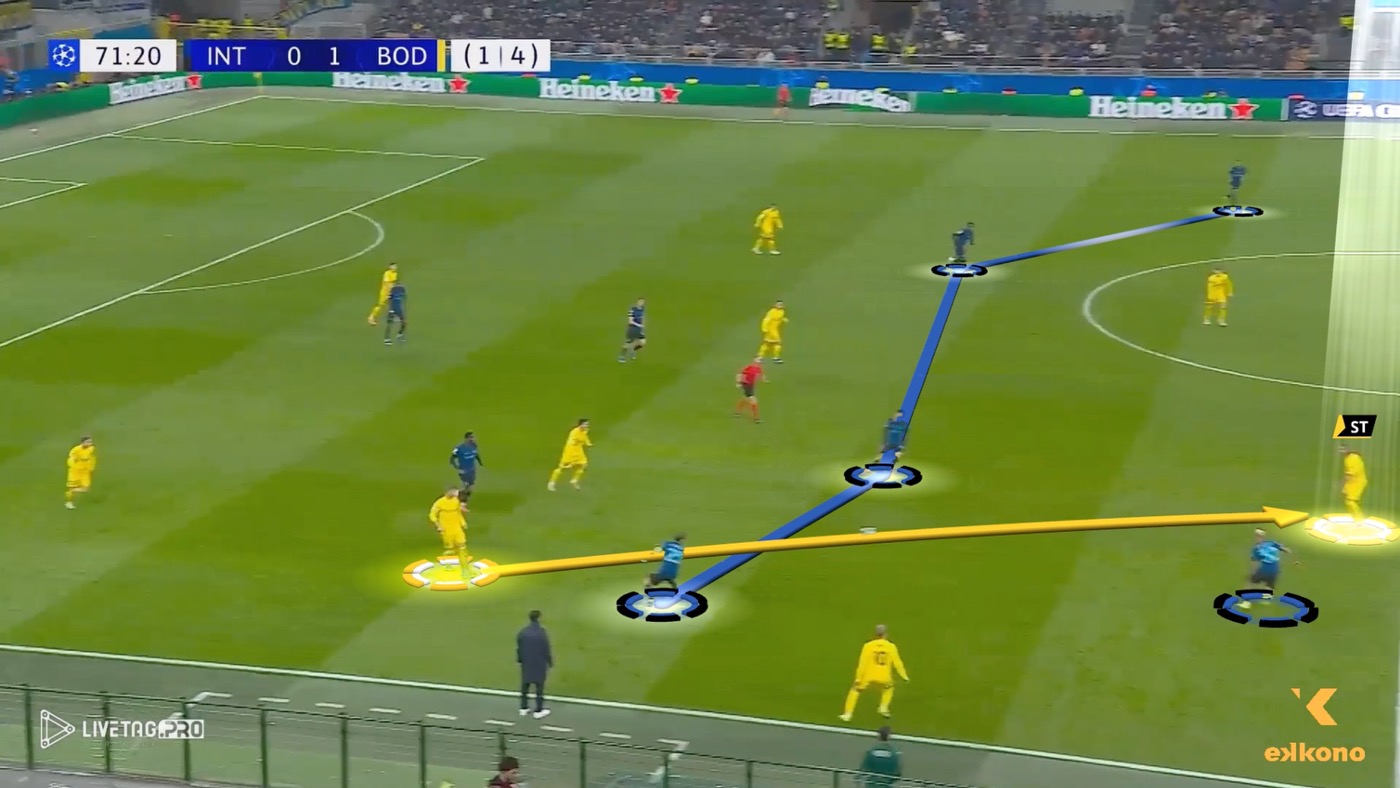
Knutsen’s Bodø/Glimt
During the offensive transition, Høgh (ST) receives behind the opponent’s midfield line, freeing space on the flank.
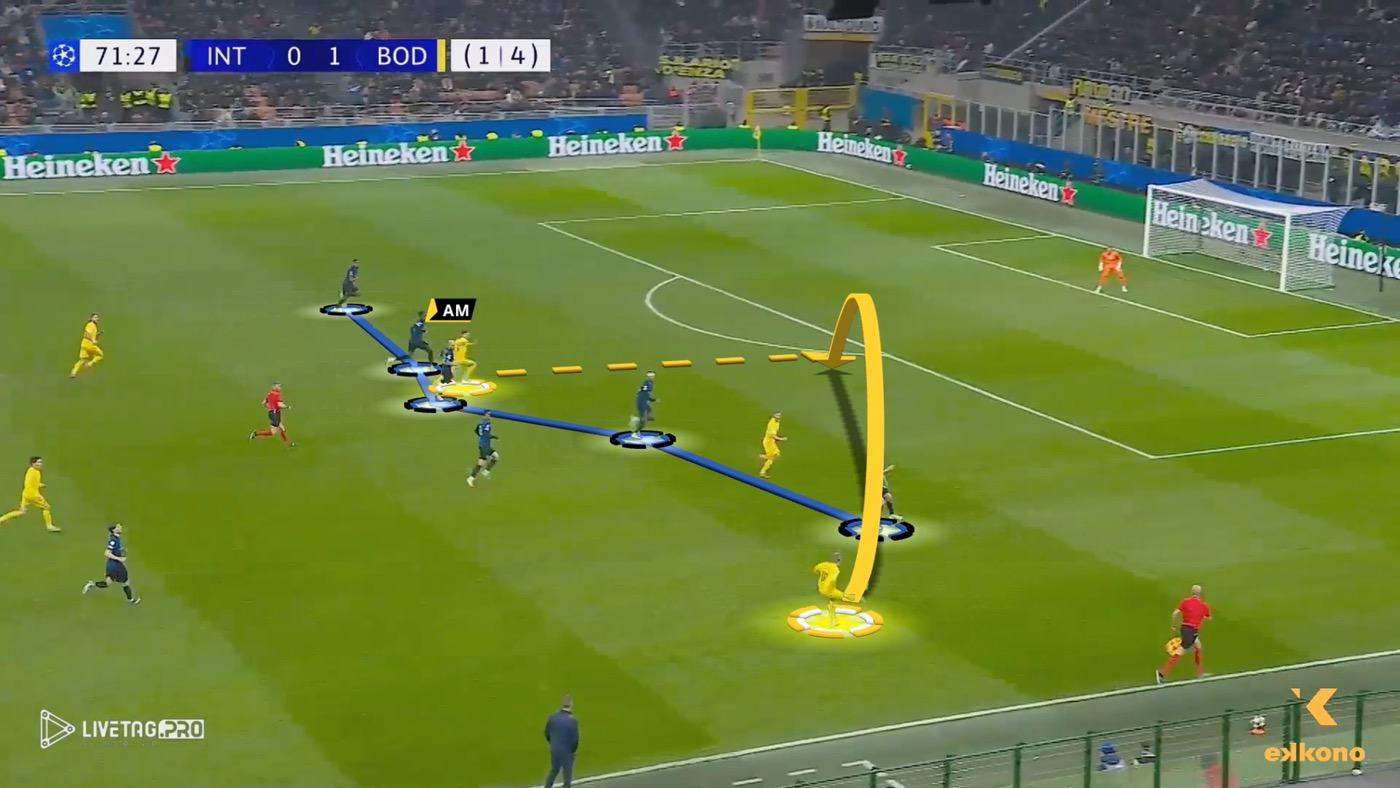
Knutsen’s Bodø/Glimt
Evjen (AM) attacks the space behind the defensive line and finishes the action.
Conclusion
Bodø/Glimt’s performances in this Champions League show how a team with clear collective principles can compete successfully against top European opponents. Their ability to combine structured attacking mechanisms, intelligent use of wide areas, and fast transitions has been key to creating advantages against strong defensive organizations.
The tie against Inter provides a clear example of these ideas in action. Through coordinated movements, positional discipline, and a strong collective understanding of the game, Bodø/Glimt demonstrated how a well-defined game model can allow a team to challenge clubs with greater individual resources.